

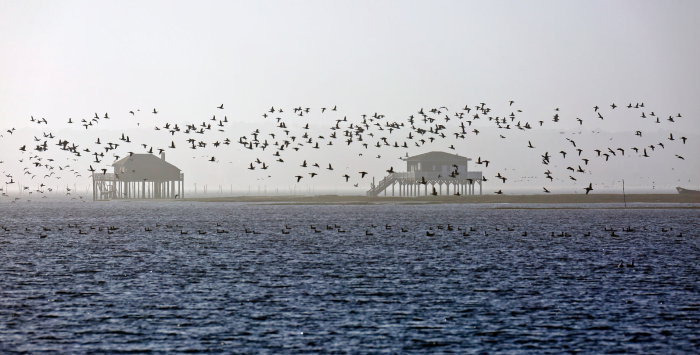
Bassin from Arcachon: as the crow flies!
The cure for your mental health? Make yourself comfortable and let yourself be transported as the crow flies on the Bassin of Arcachon, through this short video!
Did you know ? THE Bassin of Arcachon is the smallest territory in France to benefit from so many environmental protection measures and classified sites :
- 6th Marine natural park of France
- 2 National Nature Reserves : Bank of Arguin and Prés-Salés d’Arès and Lège-Cap Ferret
- 5 classified sites under natural monuments : the Dune of Pilat, Bird Island, the Domaine de Graveyron , the coastal zone of the Abatilles park and the Piraillan Reservoirs
- 6 municipalities of Bassin are part of the Landes de Gascogne Regional Natural Park
- And finally, 1 Ornithological Reserve with an area of 110 hectares of preserved natural spaces
The Teich Reserve : a bird watcher's paradise for 50 years!
Located on the commune of Teich, The Reserve is a renowned place in France for observing these oddities of ornithology! It is open all year round, and welcomes nearly 328 species of birds between woodlands, reed beds, meadows, maritime marshes and lagoons!
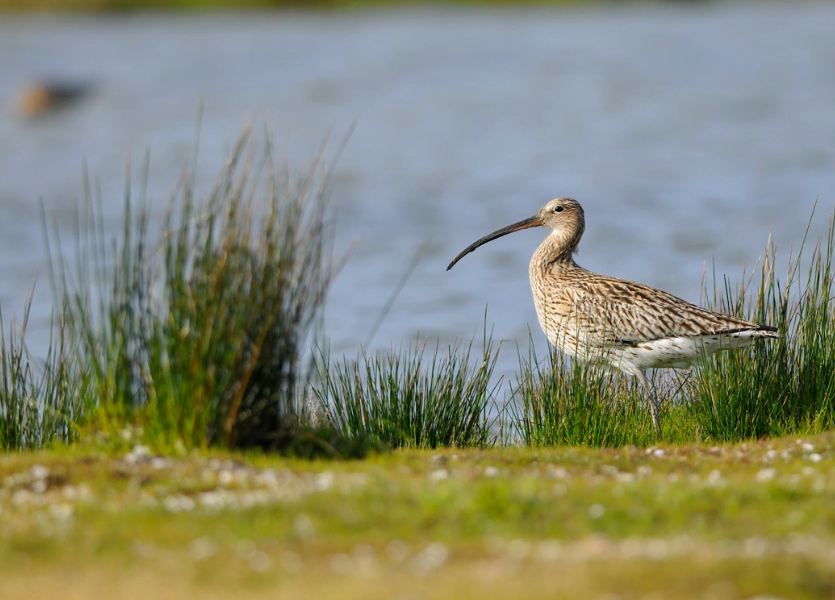
Sedentary, wintering, partial or complete migratory …the stand is modified through the seasons and tides. This spectacular result for such a small site testifies to the value of a place which offers multiple resources to birds crossing the region.
But be careful, these observations are sometimes unique, one should therefore not expect to find the species Very Rare (TR) at each visit. There "list of birds observed on the Teich Ornithological Reserve from 1972 to 2023” is constantly under construction!
The Reserve acts very actively for the conservation of the wild birds that frequent it, in particular rare or threatened species which are the subject of protection policies on a National or European scale. It is thus recognized as being of International Importance for the survival of several shorebirds and is home to threatened mammals and habitats of Community Interest.
On the route of migratory birds
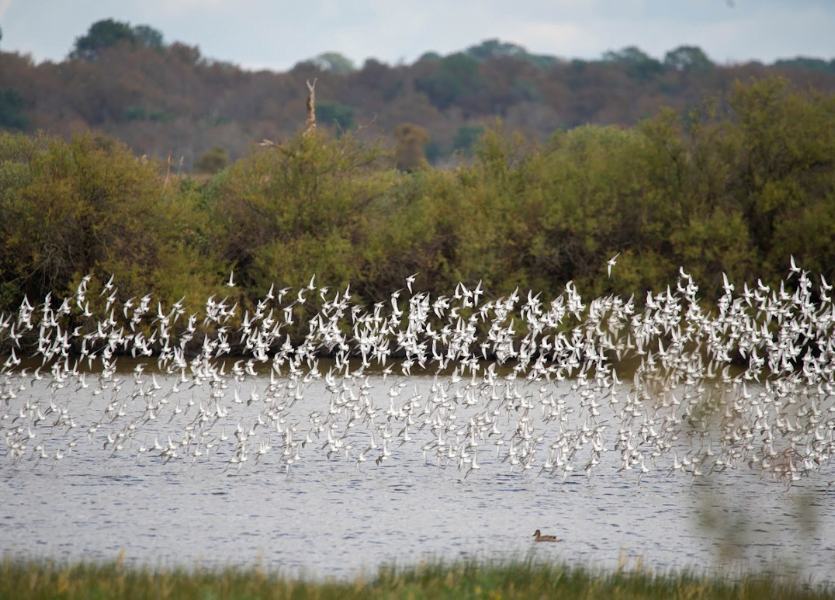
The Bassin from Arcachon is at the heart of one of the most important migratory corridors on the planet : the migratory corridor East Atlantic, used each year by tens of millions of birds from the Nordic lands (Northern Europe, Russia, Siberia, Iceland, Greenland, Canada…). A large part of these birds transit through France every autumn to reach the Mediterranean basin or Africa..
Seen from the sky, the Bassin of Arcachon forms an easily identifiable break on the coastline. The diversity of its environments offers essential resources ducks, spoonbills, geese or waders who migrate via stopovers and must rest and feed throughout their long and perilous journeys.
The Bassin houses the largest dwarf eelgrass herbarium and important eelgrass beds : a habitat which plays a role of refuge and nursery for fish, cuttlefish, seahorse, shrimp… and for the geese brave who winter each year by the tens of thousands on the Bassin: more than 18,000 in 2023!
2 migration periods to distinguish:
- Premarital migration (“before the wedding”) or “spring” or even “ascent” migration, which lasts from the end of January (Greylag Goose, Northern Pintail, etc.) to the beginning of June.
- Postnuptial migration (“after the wedding”) or “autumn” or even “descent” migration, which begins in June and ends in December. Of course, the movement of a maximum of species takes place in the middle period of each migration (March-May and September-November).
During these two phases of the life of migrants, tens of thousands of birds can frequent the Reserve for a few hours or a few days. These two periods are those when diversity is greatest on the site, and it is common to contact more than 100 species during a visit. It is also during migrations that we have the greatest chance to observe rare birds, coming from distant America or Central Asia. But like everywhere in nature, nothing is acquired in advance, and many parameters will modify the “predictions” of the best naturalists regarding the “programming” of the passage or stopover of these birds.
Of the tranquility of autumn & winter…
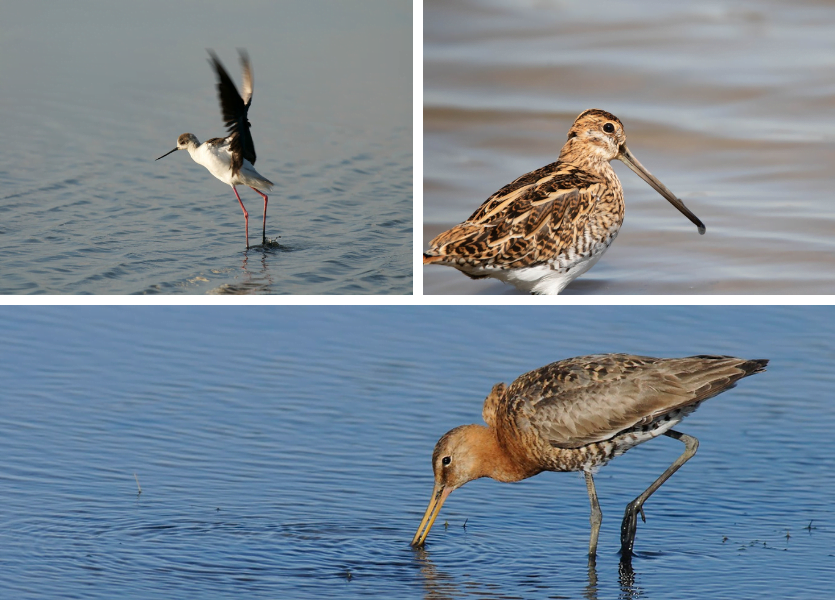
The place to be: It is THERE phase of the year when we meet thehe largest concentrations of birds on the Reserve ! A particularly interesting season for observe so-called “wintering” species, which gather in spectacular flights on the water bodies of the Reserve!
We observe from autumn gatherings of Dunlins, Curlews, Pied Avocets or Black-tailed Godwits. These birds called “shorebirds” feed on the foreshore at low tide and on the Reserve at high tide. It’s also the time to come and observe the subtle plumage of the Teal: the smallest of our dabbling ducks.
The migrants from northern and eastern Europe stop in number to spend the winter in the Reserve. This period called “wintering” begins for some in October and extends until March for others: birds only move over short distances, mainly for food.
…to the excitement of spring & summer
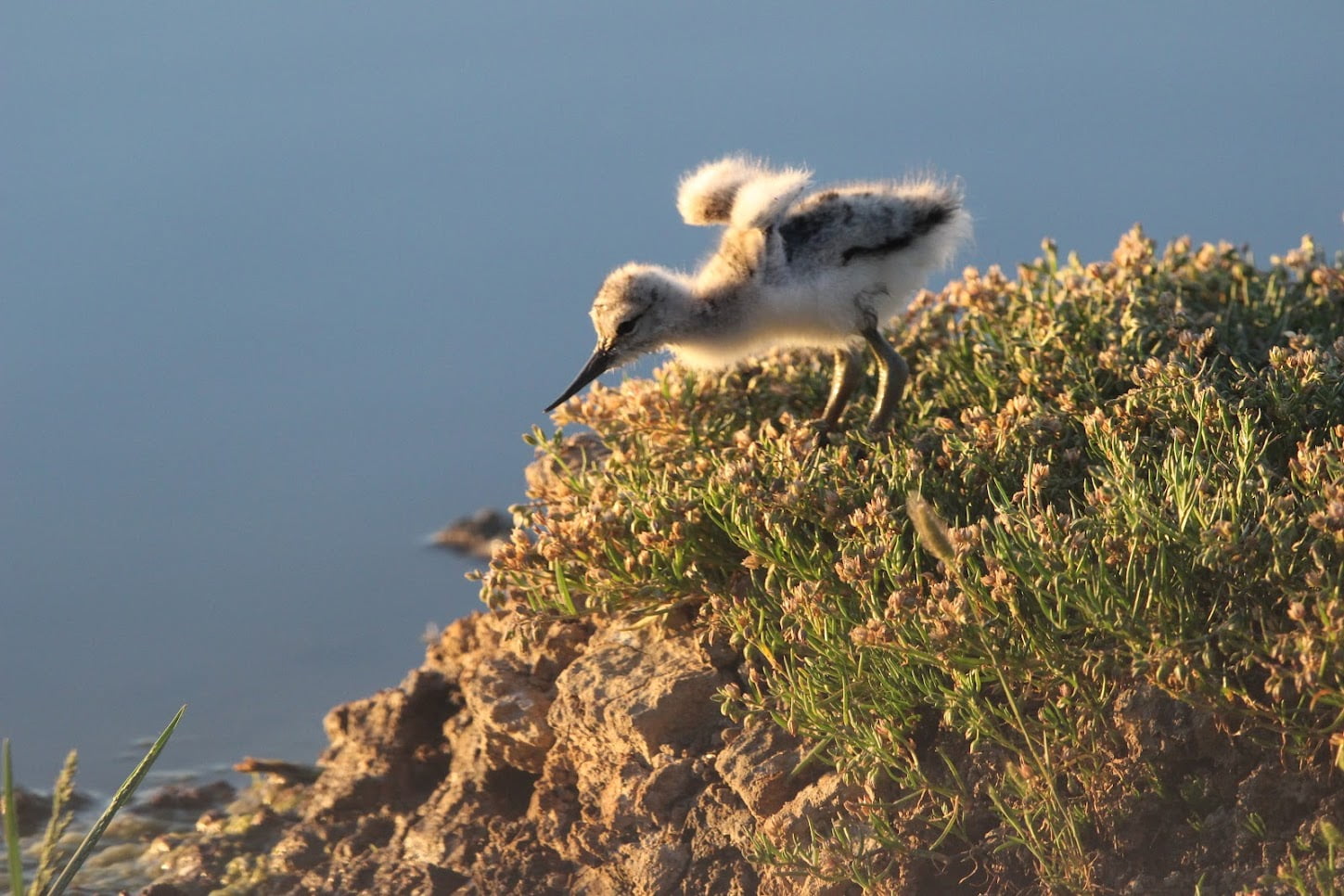
88 species nest or have already nested on the 110 hectares of the Reserve: in spring, the 20 observatories along the route allow you to see young birds from birth to flight.
As the saying goes, spring is the season of love ! And it’s not the Great Spotted Woodpecker, the Gray Heron or even the Great Black-backed Gull that will tell you the opposite. The nesting period extends from the end of January, when the first White storks return to their nests, and until the end of August with the flight of the last chicks of water rail born on the Reserve.
Passerines are particularly common, the most common like the Robin, up to the rarest like the Bluethroat with white mirror.
However, it peaks for the majority of species between April and June. Most species are very discreet during this breeding period, however several leave admire their offspring up close to the public, from observatories or trails: Black-headed Gulls, White Stilts, Little Ringed Plovers, Black Kites, Belon Shelducks…!
Main species:
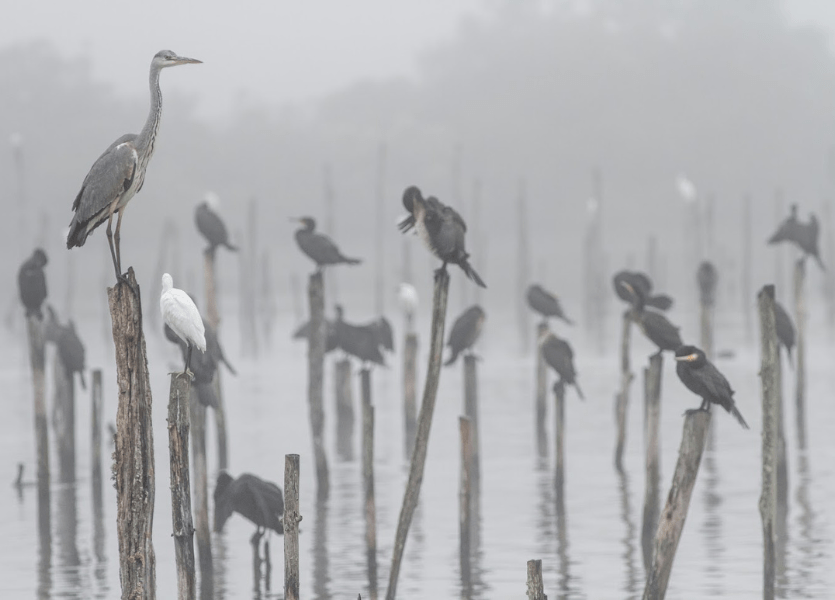
Birds : White Stilt, Pied Avocet, Eurasian Spoonbill, White Stork, Kingfisher, Nantes Bluethroat, Eurasian Curlew, Redshank, Common Warbler, Black Millan, Common Hobber, Cetti's Bouscaril, Wryneck, Dunlin, Northern Shoveler, Mallard, Northern Lapwing, Hoopoe, European Oriole, Gray Heron, Little Egret, Great Egret, Osprey, Marsh Harrier, Water Rail, Polyglot Snipe, Marsh Snipe, etc.
to be found in the Bird Observation Book of the Reserve !
Mammals : European otter, common genet, harvest rat…
Pisces : Pork mullet…
Reptiles : European pond turtle, two-lined lizard…
Plants : Rush, Tamarisk, Phragmites
A site suitable for photography:
The site has become a privileged destination for professional or amateur photographers. Its main advantages are: the diversity of landscapes and species, the regularity of a potential spectacle throughout the year, the sometimes disconcerting proximity of birds, their increasing habit of the public and the design of the observatories.
The Teich site was recently recognized as the 7th best site in Europe for bird watching, and 1st in France by the Birdwatchers community!
Visit the Reserve:
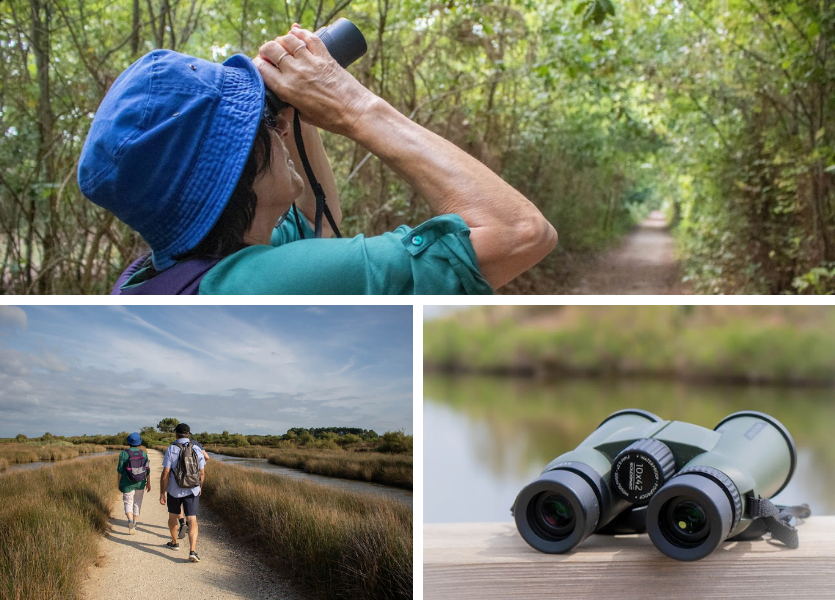
The visit to the Teich Ornithological Reserve is done on foot, along of a 6km loop trail. The route is very accessible, even in street shoes. A minimum 3 to 4 hours is expected to tour the site while observing the birds. A shortcut is possible for people traveling with difficulty or with young children (approximately 2.5 km).
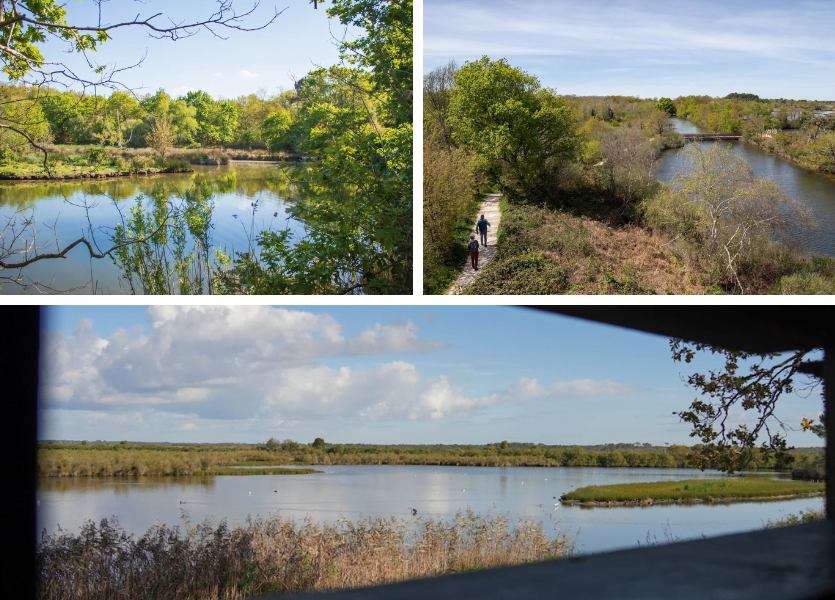
20 observation cabins punctuate the trail in the most favorable places for seeing birds. Distributed approximately every 300m, they allow a comfortable visit whatever the weather (rain, cold, heat). 4 elevated viewpoints offer a view of the landscapes of the Teich Ornithological Reserve or its surroundings.
When to come?
The Reserve is open every day except December 25. Before coming, remember to check the tide times: the birds are more numerous at high tide!